
Air Duct Cleaning: Repair or Replace? How Ballard Homeowners Decide
The answer usually depends less on age than condition. A 40-year-old sheet metal system in good structural shape is often worth cleaning and sealing, while a 10-year-old flex system with torn liners and crushed runs can already be leaking more energy than a replacement would cost. This guide walks through the inspection findings, sealing options, and energy math that actually drive the decision for Ballard homeowners. If you’d rather have a trained eye make the call on your system, call (844) 443-4768.
What inspection findings point toward repair versus replacement?
Repair makes sense when the problems are localized. Replacement tends to make sense when the failure is systemic. That distinction is the whole decision in one line, and everything below is detail on how a technician sorts one from the other.
Findings that generally point toward repair:
- Localized breaches. A handful of disconnected joints, a torn collar at the plenum, or a gap at a register boot. These are point failures, not a pattern.
- Intact liner. Flex duct with its inner liner still smooth and continuous, even if the jacket has a nick or two.
- Good geometry. Runs that are short, straight, and sized appropriately for the rooms they serve.
- Solid structure. Sheet metal that’s still rigid, with joints that can take mastic and hold it.
Findings that generally point toward replacement:
- Systemic liner failure. When the inner liner is torn, peeling, or collapsed in several runs, sealing won’t fix it. The duct is no longer a duct; it’s a suggestion of one.
- Undersized trunk lines. A trunk that can’t move the air the system needs will stay loud and unbalanced no matter how well you seal it.
- Repeated condensation damage. Ducts that have been wet and dried and wet again tend to have compromised insulation and liner throughout.
- Crushed or kinked runs. Flex duct jammed into a tight joist bay loses most of its capacity, and no amount of mastic restores a crushed run.
In our experience around Ballard, the split often follows housing vintage more than anything else. Older homes with original sheet metal frequently land on the repair side; mid-century and later homes with long flex runs in tight crawlspaces more often need replacement considered.
How do Aeroseal and mastic sealing compare as repair options?
Both seal leaks. They seal different leaks, and they suit different duct configurations.
Mastic sealing is a hand-applied coating. A technician reaches accessible joints, seams, and connections and brushes or trowels on a thick mastic compound, then wraps or tapes where appropriate. It’s the standard for sheet metal ductwork with accessible joints. It’s durable, verifiable by eye, and handles the larger gaps. The limitation is access: if a joint is buried behind drywall or deep in a crawlspace you can’t reach, mastic can’t get to it.
Aeroseal is a from-the-inside process. A sealant mist is introduced into the duct system under pressure, and it deposits at leaks from within, closing gaps that no hand can reach. It’s well suited to flex duct systems, to ducts buried in walls or ceilings, and to systems where the leak count is high but individually small. The limitation is that it seals small-to-moderate leaks, not structural failures; a torn liner or a disconnected run isn’t an Aeroseal job.
A practical rule: mastic for accessible sheet metal joints, Aeroseal for hard-to-reach leaks and flex systems in good structural shape. Many repair jobs use both. A technician who only offers one method is telling you something about their equipment, not about your ducts.
What is a leaking duct system actually adding to your utility bill?
You can estimate it without instrumentation, roughly. The math is leak fraction times heating and cooling spend. A system losing a meaningful share of its conditioned air is paying to heat or cool the crawlspace and the outdoors along with the house.
Here’s how to frame the estimate for a Ballard home:
- Look at your heating and cooling spend. Pull a winter month and a summer month from your utility bills and note the portion that’s clearly heating or cooling.
- Assume a leak range. Duct systems in older homes with accessible, unsealed joints commonly leak a substantial share of airflow. A thorough inspection can tell you whether yours sits at the low or high end of that spread.
- Multiply. If a large share of your conditioned air is escaping, a similar share of your heating and cooling dollars is going with it. On a monthly bill, that’s real money; over a heating season, it’s a number worth comparing against the cost of sealing.
- Add the comfort penalty. Leaking ducts in a crawlspace also pull in crawlspace air, which is why rooms farthest from the furnace run cold in winter and hot in summer. That’s a cost you feel rather than see on a bill.
The decision test is straightforward: if the estimated annual energy loss from your ducts is a meaningful fraction of what sealing would cost, sealing wins. If the leaks are widespread enough that the estimated loss approaches replacement cost, and the geometry is poor besides, replacement starts to make more sense. This is exactly the calculation a professional should walk you through with your own numbers.
Why does Ballard’s crawlspace flex duct need a closer look?
Because that’s where the damage usually hides. A large share of Ballard’s older housing stock has flex duct running through vented crawlspaces, and crawlspaces here stay damp through much of the year. Flex duct in a damp crawlspace is where liner damage, insulation saturation, and crushed runs concentrate.
A thorough inspection of that zone should include:
- A visual pass of every accessible run, checking for sagging, kinks, and runs pinched against joists or plumbing.
- Liner condition at the connections, where the inner liner most often separates from the collar.
- Insulation condition, looking for compressed, wet, or fallen-out insulation on the duct jacket.
- Moisture evidence, including staining on the duct jacket, standing water nearby, or a crawlspace vapor barrier that’s missing or torn.
- Joint integrity, checking taped and mastic joints for separation and old tape that’s lost its grip.
What we look for is a pattern rather than a single defect. One crushed run in an otherwise sound system is a repair. Saturated insulation and liner separation across most of the trunk is a different conversation. If your crawlspace floods seasonally or the vapor barrier is compromised, that condition needs addressing alongside the ducts, or new ductwork will end up in the same shape as the old.
Why should cleaning come before the repair assessment?
Because debris hides the evidence. A duct interior coated in dust and construction grit conceals liner tears, joint separation, and pinhole leaks that are obvious once the surfaces are clean. Assessing repair versus replacement on a dirty system means guessing.
A single visit can handle both, and here’s the sequence that works:
- Inspection first. Before any cleaning, a technician maps the system: how many runs, where they go, what material, what’s accessible, what isn’t.
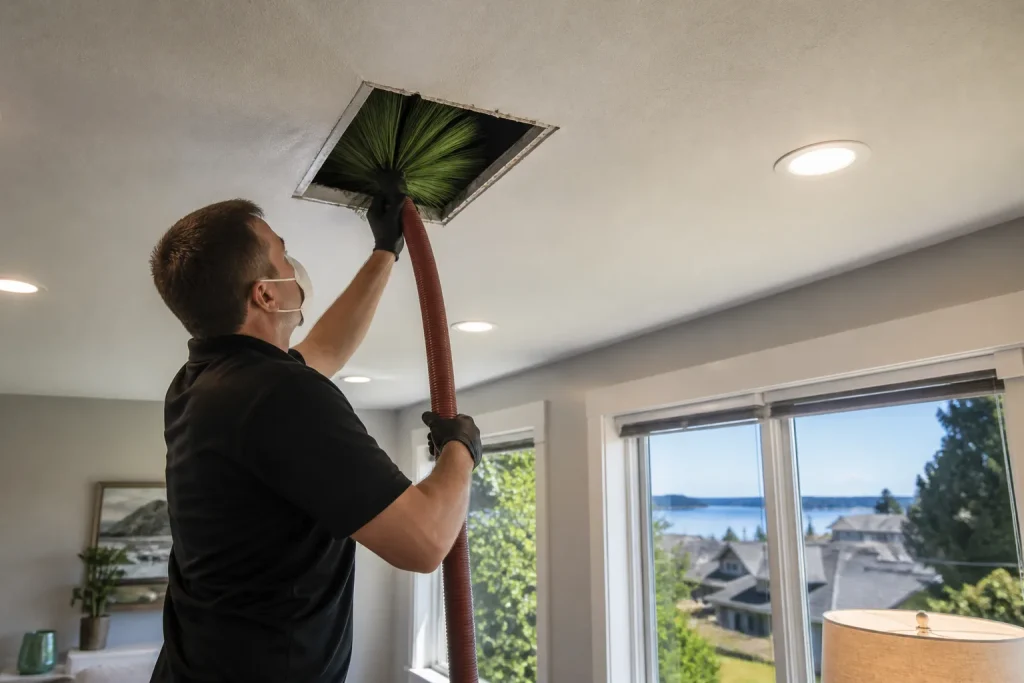
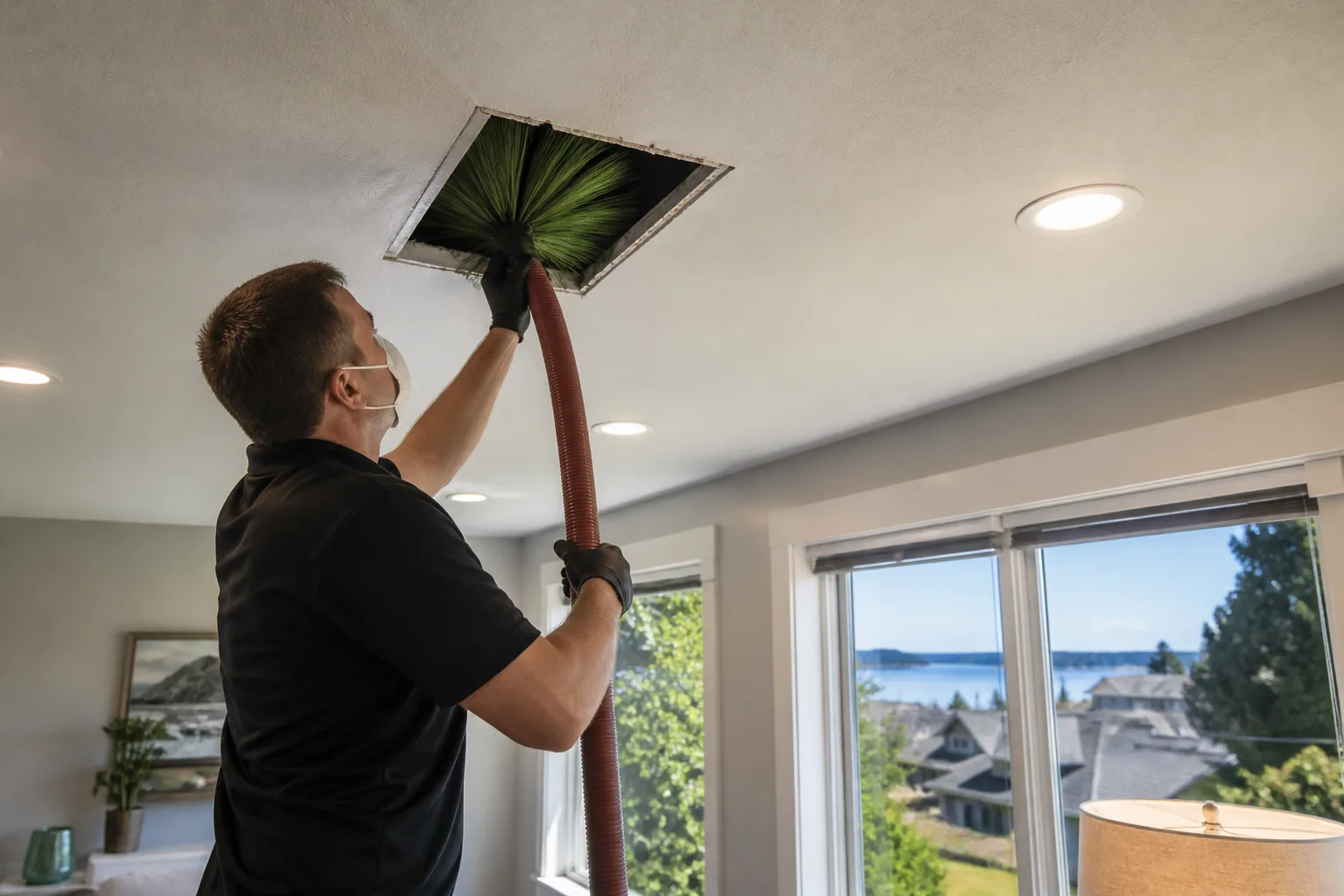
- Professional cleaning. Contact cleaning with a system like Rotobrush, plus negative-air containment, gets the ducts to bare surfaces. Negative air matters here; it keeps the dust from redistributing into the living space while the work happens. A commercial-standard setup like Abatement Technologies filtration equipment is the right benchmark for that containment.
- Post-clean assessment. Now the liner, joints, and connections can actually be seen. This is when the repair-or-replace call gets made, not before.
- Repair and sealing, if warranted. Localized breaches, joint gaps, and disconnected collars get sealed on the spot. We fix what we find rather than scheduling a second visit for the sealing.
That order also matters if you’re deciding between a full service and a single-service vendor. If the company doing the air duct cleaning can’t repair and seal what it uncovers, you’re coordinating a second visit and hoping the two findings agree.
When should you call a pro instead of handling it yourself?
When the work involves the crawlspace, the plenum, or the furnace connections, call a pro. Crawlspace access alone is a fall and air-quality risk, and cutting into duct connections to reseal them is a job with real consequences if done wrong. Duct cleaning and sealing also depend on understanding how the system moves air; a well-meaning DIY sealant job on the wrong joint can make a room worse.
We’ve found that homeowners who take air quality seriously, especially those with allergies, young kids, or a recent renovation, tend to want the inspection done right the first time. That’s the sensible call. Reach out when:
- Your ducts are more than 15 years old and you’ve never had them inspected.
- Rooms near the furnace are comfortable while far rooms run cold or stuffy.
- You’ve noticed excess dust on surfaces within a day or two of cleaning.
- Your energy bills have crept up and the HVAC equipment itself checks out.
Our technicians have up to 13 years of experience and work with professional-grade equipment from Rotobrush and Nikro, plus filtration hardware from brands like Aprilaire and Guardsman already installed in many Ballard homes. We can recommend sealing to suit the equipment you have rather than push a product line.
Related services in Ballard: if you’re deciding between a repair and a replacement, you may also want to look at air duct cleaning, dryer vent cleaning, and HVAC cleaning while a technician has access to the full system.
The Bottom Line
Age is a bad proxy for condition. What actually matters is whether your ducts can be restored to sealed, efficient performance, or whether the geometry, liner condition, and breach pattern make sealing a diminishing-returns exercise. Repair when the problems are localized and the structure is sound. Think about replacement when liner failure is systemic, trunk lines are undersized, or moisture has repeatedly taken a toll. And clean before you assess, so the call is made on what’s actually there.
If you’re in Ballard and need help, Air Duct Cleaning Ballard offers free estimates. Call (844) 443-4768. We answer 24/7. Fast dispatch from 7am to 7pm, Sunday through Friday.
Frequently Asked Questions
Typical whole-system pricing depends on the number of runs, system condition, and whether sealing or repair is included; there’s no honest per-vent number. The written estimate sets the final price, and it should be a flat price per system agreed before work starts. Call (844) 443-4768 for an exact quote: estimates are free.
It comes down to whether the damage is systemic or localized. A few accessible joint gaps and intact liner point to repair; torn liner across multiple runs, undersized trunks, or repeated moisture damage point to replacement. Cleaning first lets a technician see the actual condition. Call (844) 443-4768 to schedule an inspection: estimates are free.
Usually because they’re a coupon for a partial job, not a whole-system service. A big equipment setup with negative-air containment and the ability to seal what it uncovers costs more to run than a shop vac, and a low figure often turns into a larger invoice once a technician is onsite. Insist on a flat price per system in writing and a documented before-and-after. Call (844) 443-4768 for an exact quote: estimates are free.
Most homes don’t need it on a fixed schedule. It’s worth doing after a major renovation, when you’ve moved into a home with unknown history, or when a visible debris problem or household allergies suggest it. If you’re unsure, an inspection answers the question. Call (844) 443-4768 to book one: estimates are free.
Written by the team at Air Duct Cleaning Ballard.
Need Air Duct Cleaning Help?
Call Air Duct Cleaning Ballard - the local pro we connect you with is licensed and insured, here with fast help in Ballard.
(844) 443-4768